
How it used to be in’t olden days of racing... 🏍️ 🚗 💨

Remembering today Cyril John called “Jack “Findlay (5 February 1935 – 19 May 2007)

Jack Findlay is considered the icon of the disappearing category of private pilots who, from the fifties to the seventies, gave life to the Continental Circus, also narrated in the film of the same name. That type of racer who moved from one Grand Prix to another with the van and/or trailer with the mechanic or wife following.

He was also the first winner in 1971 for Suzuki in the 1971 Ulster Grand Prix.

For Suzuki he also won the Senior TT in 1973 at the Tourist Trophy on the Isle of Man.

His FIM Formula 750 title in 1975 which would become the World Championship in 1977.

Retirement from competitions took place in 1978.
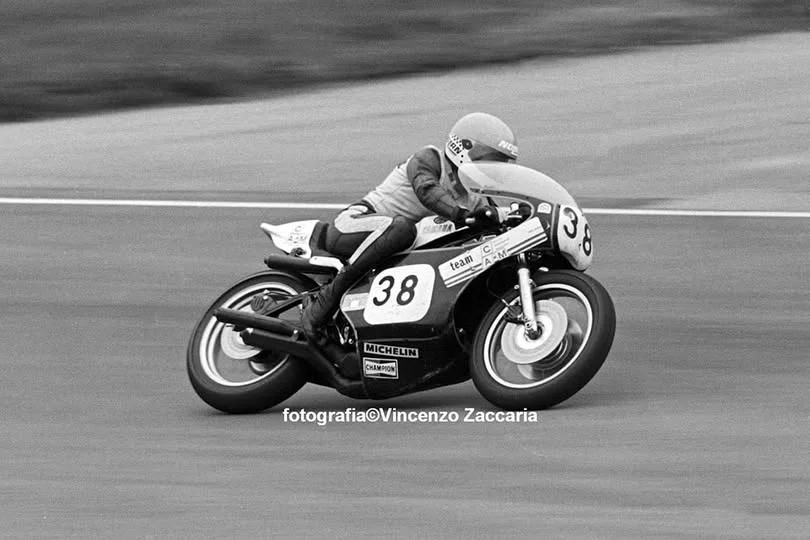


1738784844396.webp
 
Winner of the 1973, Senior (500cc) Manx Grand Prix, former Antrim competitor, Paddy Reid, has sadly passed away. He was 82 years old.

Reid, who in 2023 was a Guest of Honour at the Manx Grand Prix, 50 years after his win, was originally from Oldstone Rd in Antrim but later moved to reside in England.

Paddy, who joined the RAF, only competed in the Manx Grand Prix on three occasions, in 1972, finishing 8th in the lightweight, in 1973, second in the Lightweight, and won the Senior race in the same year.

His dominance in the Senior MGP saw him win by three minutes and six seconds, setting a new record average speed at 96.89mph.


1739492087420.webp


1739492106401.webp


1739492066197.webp
 
Mike Hailwood at the 1971 Daytona 200.

Mike Hailwood was paid an “undisclosed sum” to race for BSA in the 1970 Daytona 200, even though machine failure robbed him of any hope of beating Dick Mann’s Honda four.

The decision to return to Daytona in 1971 and spend on a magnificent scale, with a five rider dream team, was made on the promise of loans and money the BSA group (which owned Triumph) simply did not have. And the dream almost came true, despite Paul Smart and Hailwood (again!) dropping out with centre cylinder meltdowns.

Dick Mann (curiously “let go” by Honda) took a magnificent win for BSA, its first Daytona victory since Bobby Hill’s win in 1954. Mann was followed home by Romero on his Triumph followed by Don Emde on another BSA, to make the 1971 Daytona 200 a Brit bike one, two, three.— at Daytona International Speedway.

BSA might have been the parent company, and once the largest and most profitable motorcycle manufacturer on earth, but in truth Triumph was the more valuable name in the US and the Daytona winners were really Triumphs. The design and development was Doug Hele’s work from his Meriden office and the engines were prepared at Meriden. Road racing had always meant America to the group and it was Triumph people both in the UK and in the US who had worked to get these results. It was the same when the triples went trophy hunting at Bonneville Speed Week: the Triumph powered bikes came away with the records.

After decades of ill will, the Triumph and BSA teams were increasingly focussed on beating each other rather than the Japanese, in the US especially where there had been a shotgun marriage between the distributors and dealers.

Meanwhile Honda, soon followed by their countrymen, focused on the product and dealer network. Honda cared not that BSA ridiculed their turn signals, electric starters and maintenance free motorcycles (one British executive claiming “motorcyclists like to take their carburettors apart at the weekend”) because that was what Honda’s team were told that their prospective customers wanted.


1739492260100.webp
 
The late, great, Percy Tait.

1739492521906.webp


Percy Tait (9 October 1929 – 17 November 2019) was a renowned English motorcycle road racer and senior road tester for Triumph Motorcycles.

Born near Meriden, England, he joined Triumph at 21, starting on the assembly line before moving to the Experimental Department, where he became a key test rider.

His extensive testing, estimated at over a million miles, was instrumental in developing models like the Triumph Trident.

1739492614374.webp


Tait's racing career included notable performances, such as finishing second to Giacomo Agostini in the 1969 Belgian Grand Prix at Spa-Francorchamps, riding a Triumph Daytona-based machine.

1739492631450.webp
He also partnered with Ray Pickrell to win the 1971 Bol d'Or 24-hour endurance race on a Triumph triple.

After retiring from racing, Tait established a successful Suzuki dealership and became a champion sheep breeder, winning accolades at prestigious events like England's Royal Show, the Royal Welsh Show, and Scotland's Royal Highland Show with his Blue Demaine and Rouge Shearling ewes.

1739492647797.webp


Percy Tait passed away on 17 November 2019 at the age of 90, leaving behind a legacy in both motorcycling and agriculture.
 
John Williams - Senior TT 1976 - 1946-1978

Widely regarded as one of the greatest British road racers, being even capable of beating Barry Sheene in the mid-1970s, Cheshire’s John Williams was a five-time winner of the North West 200 race and competed 30 times in the Isle of Man Tourist Trophy, between 1968 and 1978.

In that time he won a total of four races, the first being the Production 500 cc Race in 1971, riding a Honda, and the last the Classic TT in 1976, on a Suzuki.

1739492701840.webp


The 49th edition of the Ulster Grand Prix was held at Dundrod, the 11.910-kilometer public road course situated north of Belfast in County Antrim, Northern Ireland, on Saturday, 12 August 1978. The event was marred by a number of accidents that resulted in the deaths of two competitors.

The first fatality occurred on the Thursday practice session. Britain's rider Jeremy Montgomery-Swann suffered a fall on the approach to Budorea fast right-hander in the back of the circuit. Among the first riders to reach the place of accident were his friends John Williams and Tom Herron, who stopped immediately and came to help. Unfortunately, they could do nothing to save the life of the unfortunate rider, Montgomery-Swann's injuries proved to be unsurvivable.

Even more sadness would pour over the Dundrod event two days later, during the 1000 cm3 Superbike race, when John Williams himself had a grevious accident from which he would die in the following night in Belfast hospital.

After taking his career's sixth outright Ulster Grand Prix win in the 500 cm3 class race on Saturday morning, after a fierce battle with Herron, John Williams was dicing for the lead of the Superbike race, once again against Herron. On the fifth lap of that event, Williams lost control of his Suzuki at the Wheeler's Corner and crashed. He was taken to Belfast hospital with what were thought to be minor injuries. Reportedly John Williams regained consciousness but passed away later that evening in the hospital. He was 32 years old.

1739492917364.webp


Sadly Tom Herron would lose his life less than a year later, during the 1979 North West 200 at Coleraine in Northern Ireland.
 
The “Rob North” BSA

The success of BSA and Triumph at the 1971Daytona 200 would be a last hurrah. Cutbacks were immediate, both companies in dire financial trouble. Many of the all-conquering factory triples were sold off, some dismantled and parted out piecemeal.

A San Francisco privateer ended up with this factory Highboy (the early Rob North frames, which he lowered for better aerodynamics to create a lowboy so retrospectively creating the highboy) .

Wanting the later modifications, the new owner returned the frame to Rob North, by now relocated to Southern California. North altered the older frame to Lowboy specs – except, it was found out later, he made a mistake. A misread of his protractor resulted in the steering head being kicked out to a rake of 32 degrees, not the desired 28. Handling suffered as the frame was much less nimble, a fault not found until the bike's next race. It was all a bit of a moot point as by this time the BSA even in top form was uncompetitive against the Yamaha TZ750 two-strokes just coming to the fore. The triple then went underground as old, obsolete race bikes often do, only to resurface in the early 1990s with the upswing in vintage road racing.

Nonetheless the triples were the most successful race bikes of their time, dominating the 750cc races in Europe and the US. Even Bert Hopwood admitted the success was due to Doug Hele's “brilliance” and greatly criticised the BSA-Triumph board's reluctance to promote him from the drawing board. Hele was offered the chance to return to Norton with their then-new F750 team for 1972, but decided to stay with Triumph, moving to BSA’s experimental team at Kitts Green.

When BSA finally folded Hele turned down a job with the Japanese and joined outboard motor makers British Seagull in Dorset. Even in his seventies he was working as a freelancer on the Norton rotary.”

1739493484915.webp
 
Isle of Man TT History

The last Velocette to win an Isle of Man TT was in 1967, when rider Neil Kelley took his Velocette Thruxton to victory in the 500cc class of the Production TT.

Kelley was a local and knew the roads well, and his bike used a special motor prepared by the factory with a ‘squish’ combustion chamber, forged piston, and needle roller cams that gave an extra 4.5hp.

About ten of these motors were built.


1739816993764.webp
 
Wil Hartog

On June 25, 1977, Wil Hartog made motorsport history by becoming the first Dutchman to win a Grand Prix in the premier 500cc class. This unexpected and sensational victory during the Dutch TT in Assen marked the beginning of a golden era for Dutch motorcycle racing.

Wil Hartog, born on May 28, 1948, in Abbekerk, North Holland, spent years combining his work at his father’s grass drying plant with a part-time racing career. Despite his limited opportunities to compete internationally, Hartog impressed with his talent and perseverance.Hartog’s breakthrough came in 1977 when he acquired a competitive Suzuki RG500. Standing at 1.80 meters tall and donning his distinctive white racing suit, he quickly earned the nickname “The White Giant.”

1739817373488.webp


1977 Assen

The conditions on that fateful Saturday in June 1977 were far from ideal. It was raining, cold, and Hartog was feeling unwell. He even considered not starting the race. World champion Barry Sheene came to his aid with a medication that kept Hartog on his feet.

1739817806247.webp


Despite his poor starting position (10th in qualifying), Hartog made a lightning start from the third row. He immediately took the lead and, except for a brief period, held onto it until the finish. In front of more than 100,000 ecstatic spectators, Hartog crossed the finish line first, making history.

1739817843482.webp


1739817767603.webp
 
Back
Top Bottom